
 Plot & Petal
Field ManualAll plants
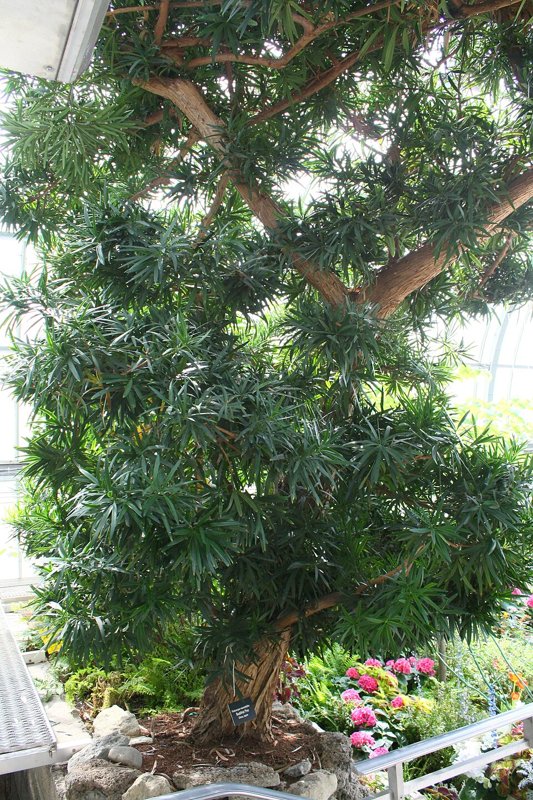
Podocarpus
Podocarpus macrophyllus
Family: Podocarpaceae
- Full Sun to Shade Tolerant
- Salt Tolerant
- Drought Tolerant
- Not a True Yew
Pet & Human Safety
People: Not researchedPets: Toxic to pets
People: not researched yet.
ASPCA lists Buddhist Pine / Podocarpus (Podocarpus macrophylla; note ASPCA's page uses this slightly different spelling from the more standard 'macrophyllus' used by NC State and UF/IFAS; same species) as Toxic to Dogs, Toxic to Cats, and Toxic to Horses: direct match under 'Buddhist Pine.' ASPCA states the toxic principle itself is UNKNOWN, and explicitly warns: 'Do not confuse with yews of the genus Taxus': true yews are a much more dangerous plant, and this plant's own common names (Yew Pine, Japanese Yew, Southern Yew) are exactly what could cause that confusion. This should be a prominent, clearly worded distinction in the app, not a footnote: getting it backwards (assuming Podocarpus carries true-yew-level danger, or worse, assuming a true yew is just 'the mild one like Podocarpus') would be a real safety-communication failure in either direction. Clinical signs here are on the milder end: vomiting (colic specifically in horses), diarrhea. NC State's independent listing agrees on toxicity to cats, dogs, and horses, and adds the specific detail that only THE SEEDS are the toxic part: the plant's needle foliage is not implicated: with a matching mild human-toxicity profile (nausea, vomiting, diarrhea).
PlotAndPetal cannot tell you whether a plant you found can be eaten. Only someone who can see the plant can identify it.
Poison control
If someone has collapsed, cannot be woken, is having a seizure or has trouble breathing, call 911 now. For any other possible poisoning, call Poison Help: 1-800-222-1222.
Emergency number source: U.S. federal law (47 U.S.C. § 251(e)(3)), read 2026-10-07.
Naturalist Lore
Historical Background & Breeding Lore
The history of this plant and its name, and how it was bred, where we have them.
Get the app: coming soonCare
- Hardiness zones
USDA 7a-9b (NC State Extension); well suited to Central Florida.
- Mature size
Highly variable by source and pruning: NC State gives 15-50 feet tall and 6-8 feet wide for the species as grown in the wild/unpruned, but notes it stays under about 6.5 feet in coastal/piedmont NC landscapes; UF/IFAS gives a similar 35-40 feet (up to 50 unsheared) by 10-15 feet spread for an unpruned specimen. In practice, landscape plantings are almost always kept much smaller through regular pruning/shearing as a hedge or screen.
- Where it comes from
Southern China to northern Myanmar, Taiwan, and Japan (NC State Extension).
How to prepare the soil, when and what to feed, and how and when to prune where that applies.
Get the app: coming soonAnatomy & Guilds
Botanical Anatomy & Characteristics
How the flowers and leaves are built and which pollinators visit, where we have them.
Get the app: coming soonField Doctor
Field Doctor
What can go wrong with this plant and what to do about it, where we have them.
Get the app: coming soonVintage Plates
Vintage Plates
Old botanical drawings from public libraries are in the app, for plants where we have them.
Get the app: coming soon