
 Plot & Petal
Field ManualAll plants
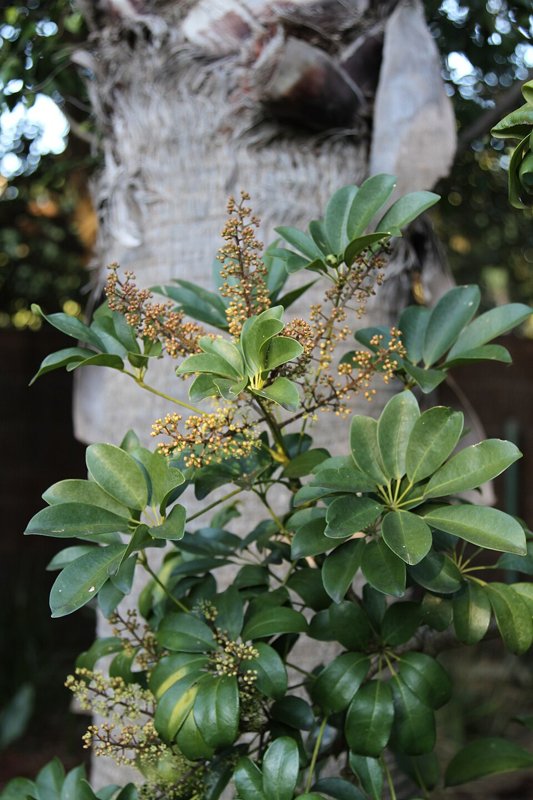
Variegated Schefflera
Schefflera arboricola Hayata (variegated cultivars)
Family: Araliaceae
- Sap can irritate skin
- Cream and gold variegated leaves
Pet & Human Safety
Toxic to people and pets
Toxic to cats and dogs. The toxic principle is calcium oxalate crystals, which cause intense irritation of the mouth and throat, with heavy drooling, trouble swallowing and vomiting (NC State, ASPCA). NC State rates its own poison severity for this species as Low, and ASPCA lists the genus as toxic to dogs and cats; trouble swallowing is still a reason to call a veterinarian or an animal poison service, which is what ASPCA's page tells owners to do if they suspect exposure. The sap also causes contact dermatitis in some people (NC State). Horses are not listed on ASPCA's page. Keep the plant where pets cannot chew it.
PlotAndPetal cannot tell you whether a plant you found can be eaten. Only someone who can see the plant can identify it.
Poison control
If someone has collapsed, cannot be woken, is having a seizure or has trouble breathing, call 911 now. For any other possible poisoning, call Poison Help: 1-800-222-1222.
Emergency number source: U.S. federal law (47 U.S.C. § 251(e)(3)), read 2026-10-07.
Naturalist Lore
Historical Background & Breeding Lore
The history of this plant and its name, and how it was bred, where we have them.
Get the app: coming soonCare
- Hardiness zones
USDA zones 9b to 11 outdoors (UF/IFAS EDIS); NC State lists 9b to 12b. Grown as a houseplant in colder regions.
- Mature size
Outdoors in warm climates the sources give 10 to 15 ft tall (UF/IFAS EDIS) or 10 to 25 ft tall and 4 to 8 ft wide (NC State); UF/IFAS Extension Charlotte County says it rarely passes 10 ft. Indoors it is typically kept to 4 to 6 ft with pruning (NC State).
- Where it comes from
China and Taiwan (UF/IFAS Extension Charlotte County).
How to prepare the soil, when and what to feed, and how and when to prune where that applies.
Get the app: coming soonAnatomy & Guilds
Botanical Anatomy & Characteristics
How the flowers and leaves are built and which pollinators visit, where we have them.
Get the app: coming soonField Doctor
Field Doctor
What can go wrong with this plant and what to do about it, where we have them.
Get the app: coming soonVintage Plates
Vintage Plates
Old botanical drawings from public libraries are in the app, for plants where we have them.
Get the app: coming soonSources
- NC State Extension Gardener Plant Toolbox, Heptapleurum arboricola (dwarf schefflera)
- UF/IFAS Extension EDIS, ENH-744/ST586: Schefflera arboricola: Dwarf Schefflera (Checked October 2026)
- UF/IFAS Extension Charlotte County (R. Mitchell, 27 Aug 2025), The right schefflera
- Clemson HGIC, Schefflera
- ASPCA, Toxic and Non-toxic Plants: Schefflera
- GBIF Species Match API, Schefflera arboricola